Tag: Lisa Rein

  • Aaron Swartz Day 2018: The Inside Story – Part 1: DJ Spooky At The Creative Commons Launch (2002)

    See DJ Spooky, along with Barrett Brown, Cindy Cohn, Brewster Kahle and others, at this year’s San Francisco Hackathon and Evening Event at the Internet Archive. (TICKETS)

    Saturday Schedule & Evening Event Projects To Hack On

    Regular Tickets Here

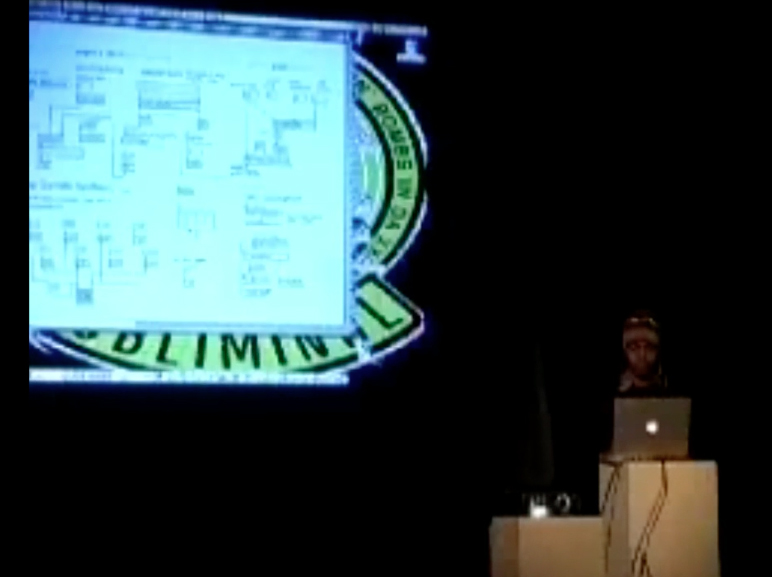
    DJ Spooky walks across the stage before his performance. Artwork up on the screen by Ryan Junell.

    By Lisa Rein, Co-Founder, Aaron Swartz Day.

    RU Sirius asked me to elaborate in detail about the history behind this year’s Aaron Swartz Day International Hackathon and Evening Event.

    To do this, we’ll need to go back to the launch of Creative Commons, in December of 2002. This is where Aaron presented our metadata vision to the world, and DJ Spooky presented and showed a trailer for what would become his classic “Rebirth of a Nation” masterpiece.

    DJ Spooky spoke and performed at the Creative Commons Launch in December of 2002.

    Video of DJ Spooky’s talk (includes trailer).

    Watch the Trailer for “Rebirth of a Nation”  (Talk not included).

    “How many of you have heard of a magazine called Adbusters? (Audience cheers.) As a kind of a sense of humor about that, they made this new flag. (He holds it up.) As a way to think about copyright culture in our era.” – DJ Spooky, CC Launch, 2002.

    DJ Spooky, December 16, 2002

    Transcription:

    Hello everyone. How are you doing?

    Some of you might know me as “Paul Miller.” Some of you might know me as “DJ Spooky.”

    The fun part about DJ Spooky is that it’s a fiction. It was meant to be a character in a novel I’m working on. It started as sort of an art project. I was living in a place called “The Gas Station” in New York. It was next to a junkyard on 2nd street. It’s been razed over and is now a condominium.

    Being in New York at a certain point in the mid 90s. It ws right on the cusp of when Digital Culture was slowly migrating out of the academiess, and really began to spread throughout the entire culture as we know it.

    So, for me, music was always a hobby. Most of my other work – and many of my peers and fellow DJs – were always kind of archivists. We’re collectors – I like to say “philanderers of the subconcious.” People who like to look for rare nuggets of sound. Rare records. Rare grooves. Rare beats. And make new mixes out of it.

    When I was first starting out, I would always make these CDs and little mixes that would say “Who is DJ Spooky?” There was a sense of humor about sort of audio theater.

    To make a long story short, when they asked me to do a piece for this, I was thinking about it. I am in the middle of about three different projects. One of them is “Birth of a Nation” I am remixing that. It’s an early D.W. Griffith film. And many copyrighted works that are pre-1920 are still accessible. The film makes kind of a statement about the ownership of culture, and of course, about ownership of memory. Collective memory.

    So that’s the project that’s going to be associated with Creative Commons. What I’d like to do is show a snippet of it. I presented an early work in progress of it at the Castro Theater.

    Essentially whenever you hear something and the idea is made, it’s always a sense of playing with memory. What I’m fascinated with in the Eldred case, is the idea of who controls memory. How can you recall an image or a sound that’s essentially part of a collective unconscious. How we think of things that just go through your mind every day and how you externalize that. That’s what DJing is about. It’s playfulness. It’s reverence for controlled memory. Reverence for the found object.

    So essentially, that’s what DJing has become. It’s almost a basic fabric; part of the the fabric of contemporary culture. So, there’s that kind of thing, which to me it becomes kind of what I like to call 21st century – a new form of folk music or folk culture. Some of you guys might have heard of the Joe Wecker case? A guy who sang lyrics about how to decode DVDs. Anybody? It was a very funny case where a kid basically sang the lyrics of how to decode DeCSS DVD control systems, and then made an MP3 out of it, and had various people show up at his door. So, it was a little bit of a hectic scene.

    Kids being who they are, they printed the lyrics to the song (on how to decode DVDs) on a T-shirt.

    (Someone hollers “woo!” from the audience.)

    And so, again these issues, always migrate. You control one thing, the net will thread its way around it. And so on and so on.

    That sense of control, one of the terms Larry always uses a lot, in his great book “The Future of Ideas” – if you haven’t read it yet; you should – is the idea of “creative co-authorship.” Being able to actually reach into a text and reconfigure it. And if there’s something we’ve seen throughout the 21st century, whether you are looking at the outside of things, or the underground or overground, it’s that sense of; whether you are looking at William S. Burroughs or the Jack Kerouac and the beats in the 50s, or the Dada scene in the 20s, or the early cinema people working with that, is that America has always been the place of “the mix.” But somehow, I think in the 19th century we were a net importer of intellectual property, whereas after a certain point we became a net exporter, and that’s when all these kinds of control issues come up.

    So, how many of you have heard of a magazine called Adbusters? (Audience cheers.) As a kind of a sense of humor about that, they made this new flag. (He holds it up.) As a way to think about copyright culture in our era.

    There’s that famous scene in Bladerunner: The main character goes into a DNA lab, where “they” own your eyes. Or they own your DNA. So, if you’re Monsanto, or one of these other companies, you can reach out and copyright, an indian in Brazil’s DNA, for example. But if you’re a DJ, and you download an MP3, all of a sudden the FBI shows up at your door. So these kinds of imbalances are very intrinsic to how we think of them.

    So, anyway, to make a long story short. What I’m going to be doing is presenting a short trailer, so to speak, of the remix of “Birth of a Nation.” In it, you’re going to hear a different soundtrack and different kind of clips of the film remixed against itself. The idea is “cinema as memory.”

    (more…)

  • Matteo Borri Explains: What the Underground Lake On Mars Really Tells Us About the Possibility of Life There

    By Lisa Rein

    This image taken from the NASA Internet site 28 April, 2000 shows the south polar cap of Mars as it appeared to the Mars Global Surveyor on April 17, 2000. Photo credit: AFP PHOTO/NASA/JPL/Malin Space Science Systems.

    We are going to jump right in to this story, since it has been out for a week and most people already think they are familiar with this story.

    The mainstream press appears have missed most of the interesting implications of these recent findings.

    So, I thought I’d head over to Robots Everywhere LLC to get some clarifications from Matteo Borri.

    Matteo Borri is on the Advisory Board for the Swartz-Manning VR Destination (An Aaron Swartz Day Production) – and is the co-lead on the Aaron Swartz Day Solar Survival Project.

    Lisa Rein: Hi Matteo! Let’s talk about the implications of the “lake” they just found on Mars. Does this mean there is life on Mars? Is that all we needed to do; find water?

    Matteo Borri: No, finding water just means it is more likely. Water does not guarantee life. But it does mean that there is a small chance that something could be alive in there.

    LR: Were the Italian scientists looking for “current life” rather than “past life?” Is that how they found it?

    MB: No. They were just looking at what the rock under the polar ice looked like.

    LR: Where exactly was the lake found?

    MB: The lake was found in the South Pole of Mars. It’s very cold there. There is about 1.5 miles of ice above the lake. Either enough salts were dissolved by the ice to lower its freezing point, or some source of heat is underneath it, turning it into a liquid.

    LR: Like an aquifer?

    MB: No. More like a big pond or small lake, with a bunch of ice on top. We don’t know how old it is.

    LR: They weren’t using any special kinds of instruments different from the ones NASA uses?

    MB: Nope. Same kinds of instruments. It was just the luck of the draw.

    It’s interesting because it tells us to look for actual living “life,” rather than just for traces of past “life.”

    This sort of under-the-ice brine lake is similar to one found in Antarctica a few years back: and there were viable single-cell critters in it. So if Mars ever had pervasive life, like earth does now, some of it may have survived under there.

    Photo: Astrophysics Professor Alan Duffy’s Twitter account. https://twitter.com/astroduff/status/1022219366102839297

    LR: Could life have evolved to survive under there to begin with, rather than being frozen under there? Similar to the extremophiles we found living in the Ocean near volcanoes here on Earth? (Although these are surviving at extremely high temperatures – like 200 degrees Fahrenheit – as opposed to low ones, like on Mars.)

    MB: Yes, but it would still need to get its energy from somewhere. And getting energy is harder in general on Mars, compared to Earth, because it only gets about 1/4 of the energy we get from the Sun, and it’s seismically dead so no volcanic vents.

    LR: You mean from something other than light, right?

    MB: Yes. Something other than light. So, something that uses something other than chlorophyll and sunlight. For that water to exist underground like that, you have to be getting some energy from somewhere. Light, heat, anything.

    LR: We now know that such organisms exist here on earth right? How some fairly-recently discovered “Extremophiles” are organisms that don’t need sunlight. (Which, in turn tells us that there are energy sources other than sunlight.)

    What do the extremophiles we know about here on Earth use as an energy source?

    MB: Well, “extremophiles” simply means life that can exist in very harsh environment. One that would normally be too cold, too hot, or too dry for other life.

    There are some simple life forms that exist near the volcanic vent (where the water goes up to 200 degrees Fahrenheit).

    An underwater organism in a submarine volcano.

    LR: And they are “in the dark,” right? No sunlight.

    MB: Right. No Sunlight.

    LR: So, how do they get their energy then?

    MB: Using the temperature gradient between the volcanic vent and the surrounding environment.

    LR: Wow. Could some kind of volcano-based temperature gradient system exist on Mars.

    MB: Nope. Mars doesn’t have any active volcanoes or seismic activity. Zero. Although, there was a lot of it at some point, but way back when, like billions of years ago.

    LR: So, the big mystery is what the hell is melting part of the ice into a big lake?

    MB: Yes.

    LR: What are the theories?

    MB: Well, the most likely theory is that salts deposits were slowly eaten up by the ice, which lowered its freezing point. Once you get some liquid, it will spread out, making that particular reaction go faster.

    (more…)

  • The Aaron Swartz Day Police Surveillance Project #ASDPSP – Reports Back: Here’s #WhatWeFound In Sacramento

    We will be discussing the Aaron Swartz Day Police Surveillance Project, its templates, latest results from Sacramento & other cities in California at this month’s Raw Thought Salon on February 8th – from 7-9pm.

    Then stay from 9pm-2am to dance and hang out in Grumpy Green’s super special Psychedelic Chill Room (an immersive space for both dancing & chilling). DJs include: Melotronix, Tha Spyryt, mangangs, Ailz, & Cain MacWitish – with visuals by Projekt Seahorse – all at our February 8th Raw Thought at the DNA Lounge in San Francisco! TICKETS

    By Lisa Rein

    These simple letter templates can compel the Police and Sheriff Departments of a given city to provide you with documentation regarding every type of surveillance equipment in existence for a given City (Police) and saCounty (Sheriff).

    It’s a roundabout way of determining what surveillance equipment is being used on the public in a given city, but since it’s all we have, at least the #ASDPSP project will make it so much easier for journalists and the public to get their hands on this information.

    In this third installment of our series, Tracy will help us understand more about what we found in Sacramento, and how do approach local politicians to put pressure on them to do something about it, by implementing a “surveillance policy framework.”

    Here’s are the first two interviews of this series:

    Interview with Oakland Privacy’s Tracy Rosenberg On The Aaron Swartz Day Police Surveillance Project

    How a little “working group” stopped Oakland from becoming a mini-fusion center for the Department of Homeland Security.

    Tracy Rosenberg, co-founder of the Aaron Swartz Day Police Surveillance Project, explains #whatwefound in #Sacramento using our project’s letter templates and Muckrock, an online platform for filing public records requests.

    Aaron Swartz (above). The Aaron Swartz Day Police Surveillance Project helps journalists, researchers and anyone else who might be curious about what types of surveillance equipment are already being used by law enforcement in their towns, by providing letter templates for filing public records requests with that same aforementioned local law enforcement (Police and Sheriff Departments). Photo Credit: Quinn Norton.

    The Police Surveillance Project at Aaron Swartz Day aims to empower journalists and citizen researchers with pre-written letters that use just the right language to compel a city’s police or sheriff departments to hand over the relevant documents.

    There is much to be done once the evidence is in-hand, but getting that evidence can be half the battle. These letter templates make it easy to use Muckrock and quickly file a large set of public records requests to the Police and Sheriff Departments of a given city.

    We recently added two new templates that include the use of facial recognition software, since it came out recently that Amazon has been literally giving away its facial recognition software to law enforcement. I explain how to use the letter templates here. There are 10 templates now that can be used for both the Police Department (city) and Sheriff’s Department (county) of any given geographical area.

    Once you get the information back on a given city, you can begin to determine exactly which types of surveillance equipment a city’s police and a county’s sheriff departments have already purchased. Then, gradually, you can bring attention to the existence of the equipment to the relevant City’s City Council, in order to start the process of implementing a “surveillance policy framework” in that town.

    As we learned in an earlier interview with Tracy, Occupy activists learned these techniques in the process of finding out what the City of Oakland was using on its citizens during the #OccupyOakland protests several years ago. Once Oakland’s City Council were given evidence that the surveillance equipment existed, they could (eventually) do the right thing, and put a Surveillance Policy Framework in place regulating how it is allowed to be used.

    Your town’s City Council could do the right thing too, but first you will probably have to provide them with proof, direct from the Police and Sheriff Departments themselves, that this kind of surveillance equipment even exists.

    However, when you get the documents back, it’s important to make sure you really understand what you think you might have found. That’s what thus week’s interview is all about; understanding the documents you received back, so you can make a list and hand it over, with the supporting documentation, to your City Council members.

    LR: Here’s a list of the equipment we recommend asking about with the letter templates for each in .doc & .pdf formats). It’s best to file a separate public records request for each kind of equipment.

    The trick is knowing how to write the letters; and you have done that for us already. Thank you so much.

    TR: My pleasure. As we discussed earlier, these letters cover most known basic equipment that your local city and county might be using, including: drones and flying over head cameras, license plate readers, policing predictive software, social media monitoring software, stingrays, and most recently, facial recognition software.

    LR: Since I asked you to create a template to address what we just learned about Amazon’s Rekognition software, something the ACLU is very concerned about.

    TR: Yes. Unfortunate but necessary.

    LR: Why these pieces of equipment?

    TR: We are asking about these pieces of equipment because we already know that there is a good chance that big police departments will probably have all of it. The smaller ones will at least have some of it. But you have to ask about all of it, because sometimes they are using it in secret, and you never know until you ask.

    LR: We have already received word back from Sacramento. Let’s talk what we found in Sacramento, and you can tell us how we might go about getting that information to our Sacramento representatives.

    (more…)