All Posts

  • KLF at the Brit Awards Show 1992 — Machine gunning the audience (and a Dead Sheep)

    KLF at the Brit Awards Show 1992 — Machine gunning the audience (and a Dead Sheep)

    negotiations had broken down following their plans to fill a stage with angels and Zulus and arrive on the back of elephants.

    An Excerpt from KLF: CHAOS MAGIC MUSIC MONEY by John Higgs


    With hindsight, it was Jonathan King that killed the KLF. His fatal blow was an innocent-sounding comment. His words may not have split the group immediately, because Cauty and Drummond had too much momentum to stop straight away. But it was only a matter of time, as the implications of what he had said could not be ignored for long. The KLF staggered on for another three months, too stunned to realize that they were already dead.

    It was February 1992 and the KLF had just won the ‘Best Band’ award at the Brit Awards. Jonathan King was the producer of the awards show, and he had been asked what he thought of the KLF’s live performance at the show. “I enjoyed it”, he said.

    He enjoyed it. There was nothing else for it. It had to end.

    King is a music producer, TV presenter and a recording artist who has sold over 40 million records under various pseudonyms, most of them novelty singles. As he busied himself backstage at the Hammersmith Odeon organizing the 1992 Brits Awards, he was forty eight years old and dressed in a garish shell suit and a baseball cap with ‘KING’ stamped in metal across the front. In the coming decade he was named ‘Man of the Year’ by the BPI, praised by Tony Blair and convicted of multiple sexual offences on underage boys, so in many ways Jonathan King could be said to personify the music industry. King’s acceptance had, on a symbolic level, signified the music industry claiming Drummond and Cauty for itself.

    Drummond and Cauty’s problem with the music industry wasn’t the usual adolescent anti-authoritarian posturing that is so common among musicians. It was the result of bitter experience. By that point Cauty and Drummond had twenty-five years’ experience in the industry between them, from running record labels to producing, working in A&R, being in unsuccessful bands and being pop stars. They knew what the music industry did to people, and they also knew what it had done to them. But by then they also knew how much they had been formed by it. It had shaped their lives and left them feeling corrupted, but it was also an integral part of who they were.

    It’s still surprising that they were asked to provide the opening performance for that year’s Brit Awards show. They had been asked to appear the previous year, but negotiations had broken down following their plans to fill a stage with angels and Zulus and arrive on the back of elephants. The deal breaker, with hindsight, was probably their plan to chain-saw the legs off one of the elephants. The elephant, they said, represented the music industry. The organizers understandably walked away at this point, but they should have realized then that they were not dealing with stable individuals. (more…)

  • Some Comments About The Transhumanist Project (2014)

    by R.U. Sirius

    One problem is the underlying philosophical assumptions that enhancement is always enhancement or is just enhancement. And I always think of Marshall McLuhan’s dictum that our extensions come with amputations.


    These are some comments that I wrote in response to some questions from Peter Rothman on the h+ website in 2014


    Transhumanism as an ism — or a belief system — is probably about the right of individuals and, possibly, the human species as a whole (or large groups therefrom) to self-enhance and to engage in an experiment in self-directed evolution, in a literal sense. In other words, not that we merely have glasses and cell phones but that we might become something other, in a biological and/or perceptual sense.


    I don’t think it’s necessarily optimistic and I don’t think it’s necessarily rationalist, (particularly when we’re talking about people who think they’re pretty darn rational, who can only really be responded to with satire). I do think rationality and technology — stuff that actually works — are the fundamental tools for attaining an increasingly transhuman or posthuman condition. But tools are not, in and of themselves, paradigms. So individual transhumanists may feel like rationalism is a fine tool for living well but not the essential factor in actually living or even in apprehending what life is about… to the degree that can even be done, or in having social relationships.


    My ongoing support for the idea of transhumanism is partly a rare acquiescence  to foolish consistency. I’d like to see if the project of a positive radical mutation of the human condition suggested by people like Timothy Leary can somehow win the day; whether, with the engineers and scientists in the vanguard of making it possible, we alternatively minded mutant types can pull a few aces from the bottom of the deck and actually somehow transform this pinched, mean, surveilled, existentially barren and risky 21st civilization into something that feels like liberation, generosity and heightened awareness. At this moment, the tools that could be applied to such a state of affairs are gathering, but the memetic and environmental thrusts lean towards epic failure.

    (more…)

  • Mathemagician Ralph Abraham: We Need Another Miracle

    A little wind here, and the atmosphere interacts with the geosphere interacts with the biosphere interacts with the noosphere interacts with culture politics and society, and eventually back into the atmosphere. Huge nonlinear feedback loops. You, Ralph and I are part of a whole system that can’t be reduced to separate parts but must be understood as a whole.

    by Giulio Prisco

    I missed Mondo 2000. The internet wasn’t a thing in the late eighties, and I lived in Europe (still do). I didn’t miss Wired — I immediately subscribed after stumbling upon the first printed issue — but I didn’t realize that it was a watered-down commercial version of something more interesting.

    Now our esteemed host is bringing Mondo back, and I hope this new online magazine will be as epoch-making as the original printed Mondo. In the meantime, we can find PDFs of some old Mondo issue collected in the Mondo 2000 History Project and other archives.

    Had I been a Mondo reader in the late eighties and early nineties, I would have loved finding chaos and complexity prophet Ralph Abraham there as a frequent contributor.

    I knew of Ralph as the mathematician who wrote “Foundations of Mechanics,” which I loved to read instead of my boring college textbooks to try and understand some of the magic of differential geometry and its applications to Einstein’s cosmology. I understood maybe ten percent, but that ten percent was useful.

    Ralph seems to consider his life as a square university professor as a boring prelude to his real and very unsquare life as a cyberculture icon and explorer of the wildest fringes of mathematics, physics, history, society, life, the universe and everything. (more…)

  • Punching A Nazi (Video)

    https://www.youtube.com/watch?v=mdcXwLkpRUY

    Punching A Nazi

    Creosote Cowboy

    R.U. Sirius – Charlie Verrette – Acatelysteleven

    Musical Production Daddy Phriday & Creosote Cowboy

    Video by Daddy Phriday

    with vocals from Acatelysteleven

    lyrics by R.U. Sirius (w. help from Acatelysteleven

    Killing an arab
    Punching a nazi
    Albert Camus won’t
    Bring back the Stasi
    Kissing a baby
    Pinching a lady
    Oh Mr. Mansplain
    You so crazy

    Banning an Arab
    Punching a nazi
    Even Ayn Rand was
    Never this bossy
    Dating a Barbie
    Making a killing
    Those were the days
    Oh wasn’t it thrilling

    Killing an arab
    Punching a Nazi

  • It’s KLF Day In Liverpool!

    Their subversive intrusions into ordinary mediated reality made the Sex Pistols look like Engelbert Humperdinck..

    The KLF (otherwise known as The Justified Ancients of Mu Mu, The JAMs and the Timelords) were huge in Great Britain in the late 1980s into the mid 1990s but here in America they were virtually unknown.

    Today, August 23, in Liverpool, they return after a 23 year hiatus to do …  something.  We don’t know what. And yes, all this 23 stuff and JAM stuff refers to Robert Anton Wilson’s various playful obsession.

    (more…)

  • What’s It Like Being God? Pull Quotes from High Frontiers Issue #3

    Pull quotes… from High Frontiers issue #3 for you to chew over. (High Frontiers was the predecessor to MONDO 2000.)

    HF: What’s it like being God? Rosalie Blue: It’s like Doonesbury suddenly getting up off the paper and seeing that he’s always been flat.


    They had to have a new domestic enemy and, of course, drugs are the perfect scapegoat. People that use drugs tend to be dissident.  Timothy Leary


    …they were working on a combination L-dopa/parlodel on Parkinson’s patients in their 70s and 80s. The old ladies and old men started fucking like fiends. Durk Pearson


    The human brain is 50,000 years out of date. It evolved in a nontechnological world where the basic tasks were hunting, gathering, agriculture.  Anonymous Unit


    The machines produce immediate effects. I don’t think that they are as powerful and noticeable as the effects you might get from a chemical dose. Michael Hutchison


    In the electronics field, when you put something out, you are protected only by your speed in putting the next thing out. Lee Felsenstein


    Fringe scientists are interested in time travel, telepathy, psychokinesis, tantric sex, hypnosis, psychedelic drugs, wild card models of mind, God and universe  Nick Herbert (more…)

  • Fat Stream (Short Story)

    by Rudy Rucker

    Images supplied by Rudy Rucker

    I’m Zak, and I hang with this highly charismatic woman, Zik. We have a streamer show out of San Francisco. It’s called ZikZak. I’m the eye, and Zik is the star. She’s a natural, people can’t stop looking at her. Gestures, voice, expressions, phrasing—she reels them in.

    Me being the eye means I wear a helmet with eight outward-pointing cameras, also a pinhead selfie cam aimed at my face. Our stream’s users are interactively immersed, that is, we’re sending them so much data that they’re in a reality bubble containing Zik and me. They can move around in our virtual space, and they can look any direction they please. Ambient eyeball kicks. They imagine they’re with us, a member of our posse.

    Since I’m the eye of our reality bubble, the patched-together image of my body is fubar. Our streamware filters out this degraded geometry and replaces it with a textured wire-frame model of me. We use my live selfie stream for the model’s face. Not that I’m anything special to look at. A skinny single guy in his thirties. Sadly yearning for love. Never the right woman, never the right time.

    Zik is the one the users watch. My hi-def cameras lock onto her. She wears a couple of pinhead selfie cams as well, filling in any bits that my cams don’t cover. Most of the users hang close to Zik—some of them watch her from an inch away. Not that she sees them. (more…)

  • Some Love For Tina Fey From Charlottesville

    by Siva Vaidhyanathan

    So many people are holding Tina Fey to task as if she were a political activist/strategist/theorist.

    Here is where I am coming from. I live in a city of 50,000 people surrounded by a county of 100,000 people — none of whom have laughed in a week. Last night Tina Fey wore a UVA sweatshirt, showed us that she is still one of us, and shared a maelstrom of rants against inhumanity and cruelty. She gave us a way to channel our rage and sorrow toward laughter. Today I found universal applause from every person in Charlottesville with whom I spoke (a small sample, to be sure) and it bonded us. It lifted us. Then I found a series of Tweets and hot takes intended to deny us the pleasure of pleasure. And I resented it. I saw people who share disgust over racism and hatred with me and with Tina Fey proclaim their moral superiority when — as Cathy Davidson writes, “We have vicious hateful real enemies.” So, if you can’t make me laugh right now, I understand. Almost nobody can. I miss laughing. But don’t begrudge me for laughing, begrudge Fey for trying to make me laugh in solidarity with a recognition of brutal absurdity, or deny me one of the few pleasures available to us right now. We needed her. I’m sorry if those far from Charlottesville can’t understand that. Please cut me and her some slack.

    Siva Vaidhyanathan is Director of Center for Media and Citizenship at University of Virginia. He is writing a book about Facebook

  • The 7B2 in Handel Gothic (It is steampunk)

    lThat nag of the wristwatch to be real, be present, and to stick by one’s intended boundaries of privacy is more powerful than the nag of the phone. The phone nags differently.

    by Woody Evans

    @woodyevans

    I regarded it, but this little Casio did not regard me as I settled onto the toilet. In that moment, the watch won me over, and now I’m in the analog-gadget bag, big time.

    The face is marred at the fifty-six-minute-mark on this black resin Casio MQ24-7B2 wristwatch. It is physical, is analog, it doesn’t quite fit the left wrist right, and I love it. It’s just too small for me except when worn on the last couple of notches, and over the last year I’ve banged it up working in the yard; some third of a millimeter of plastic is gouged out on the southeast or five o’clock side — scraped the fencerow or something, I dunno.

    Over this first year, though, it has kept time to within thirty seconds (runs a little fast), and the numerals’ font is a  homogenous mix of the slightly-too-serious and the slightly-sci-fi (in the Handel Gothic family, @greatdismal (aka William Gibson) and his Twitter friends suggest).  It is “water resist.” My son gave it to me last year— unclear why he thought it important, but he turned out to be right.

    I love this watch for all of the above particularities, and I love it more than any other wearable bit of tech I own.  I’ve got a few small blades, including a thumb-sized Mad Max looking lockblade that rides on my keychain. I go, too, for a Night Ize first generation DoohicKey, which isn’t exactly a knife, but has a beveled edge which works for most minor box-cutting-type jobs, carabines onto my extant keyrings, and works as a wrench, bottle opener, and a 40 millimeter ruler. I have a small red SanDisk .mp3 player that’s going on 10 years old, but still works great. Then, in my pockets, I have tins and a palmable plastic bottle or two for mints or meds… and, of course, the phone (Samsung Galaxy S4 — glass face replaced last month after a proper shatter on ceramic tile as I leaned into the fridge for beer and it leaned out of my shirt pocket for gravity). (more…)

  • Operation Mindfuck Was Too Successful

    “Sartre said hell is other people. Now, hell is other people’s tweets or posts.They just irritate the crap out of all of us. The feeling is mutual.”

    R.U. Sirius & Douglas Rushkoff in converation

    I’m inspired by comments here from Grant Morrison and from John Shirley to share this again. It was previously posted on Medium on May 21

    “Sartre said hell is other people. Now, hell is other people’s tweets or posts.They just irritate the crap out of all of us. The feeling is mutual.”

    On April 5, I was on Douglas Rushkoff’s Team Human radio show. We agreed to get the interview transcribed for possible publication somewhere.

    I’ve decided that rather than trying to edit a truncated version to pitch to more popular websites, I’m just going to keep it conversational and run it here. Maybe less people will see it, but that’s ok. I get to say what I want.

    I’ve added to my own spew as I edited. We hope you enjoy.

    DOUGLAS RUSHKOFF: I came in contact with your work for the first time at a psychedelics conference in Los Angeles. Albert Hoffman and Laura Huxley [Aldous Huxley’s wife] were there. Timothy was there, and I think Ram Das and Ralph Metzner. It was the original psychedelics crowd.

    And there were a bunch of issues of your first magazine, High Frontiers. And to me it was like a calling card from the future.

    I was in my early 20’s, and your magazine was an amalgamation of everything that I had been interested in yet had never seen connected before: cultural, scientific, biological, cosmic, spiritual, and pharmacological advances, all in one place. How did physics and math and drugs and music and culture and transgender and cultural alchemy all end up considered part of the same strand of cultural information? How did you come up with that?

    R.U. SIRIUS: In a way, it just came together in my head. I assumed that there were other people out there like me. Sort of like what Paul Krassner said about starting The Realist at the start of the ’60s. He put it out to meet the other aliens…

    So this was a new generation of aliens.

    And to me, the generational aspect of it was important. And the cultural aspect of it was important. Because even though I was from a generation that had a lot of hippies and deadheads and so on, we were also the people who created the cultures of punk and new wave. I was in my mid-twenties when all that came along and it was a refreshing blast to my pot-soaked mind.

    So I was adapted for a very speedy, hyper, futuristic mentality by that, as well as by scientific ideas and psychedelic ideas and so forth.

    And by the time we were doing High Frontiers in the mid-80s, one could clearly see the so-called digital revolution coming on, and one could be fairly optimistic about it… actually, radically over-optimistic. (laughter) So all these things just felt like the makings of a truly contemporary magazine.

    DOUGLAS RUSHKOFF: High Frontiers really ran the full gamut of hallucinatory experiences. It was a flag in the sand. Leary had said, “Find the others.” And this was saying to a new generation, “Yes, there are others. These are our experiences.”

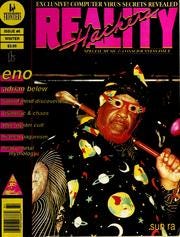
    But then, you turned it into Reality Hackers and eventually Mondo 2000. It became the voice of this 21st century post-television, designer-reality society.

    R.U. SIRIUS: Yeah, the Jetsons on DMT, as Mark Dery snarkily labeled it. (more…)